
Executive Summary: The Transformation at a Glance
JoinAds, a dynamic platform connecting publishers with premium advertising demand, faced a critical inflection point. Despite having access to quality inventory, their internal team was bogged down by manual optimization processes and a lack of specialized programmatic expertise. This operational bottleneck was capping their growth potential and diverting crucial resources from core development.
“Before AdTech Media, our ad ops were a constant guessing game. Now, our revenue is on autopilot, growing consistently while we focus on creating content for our community.” — Marketing Director, joinads.me
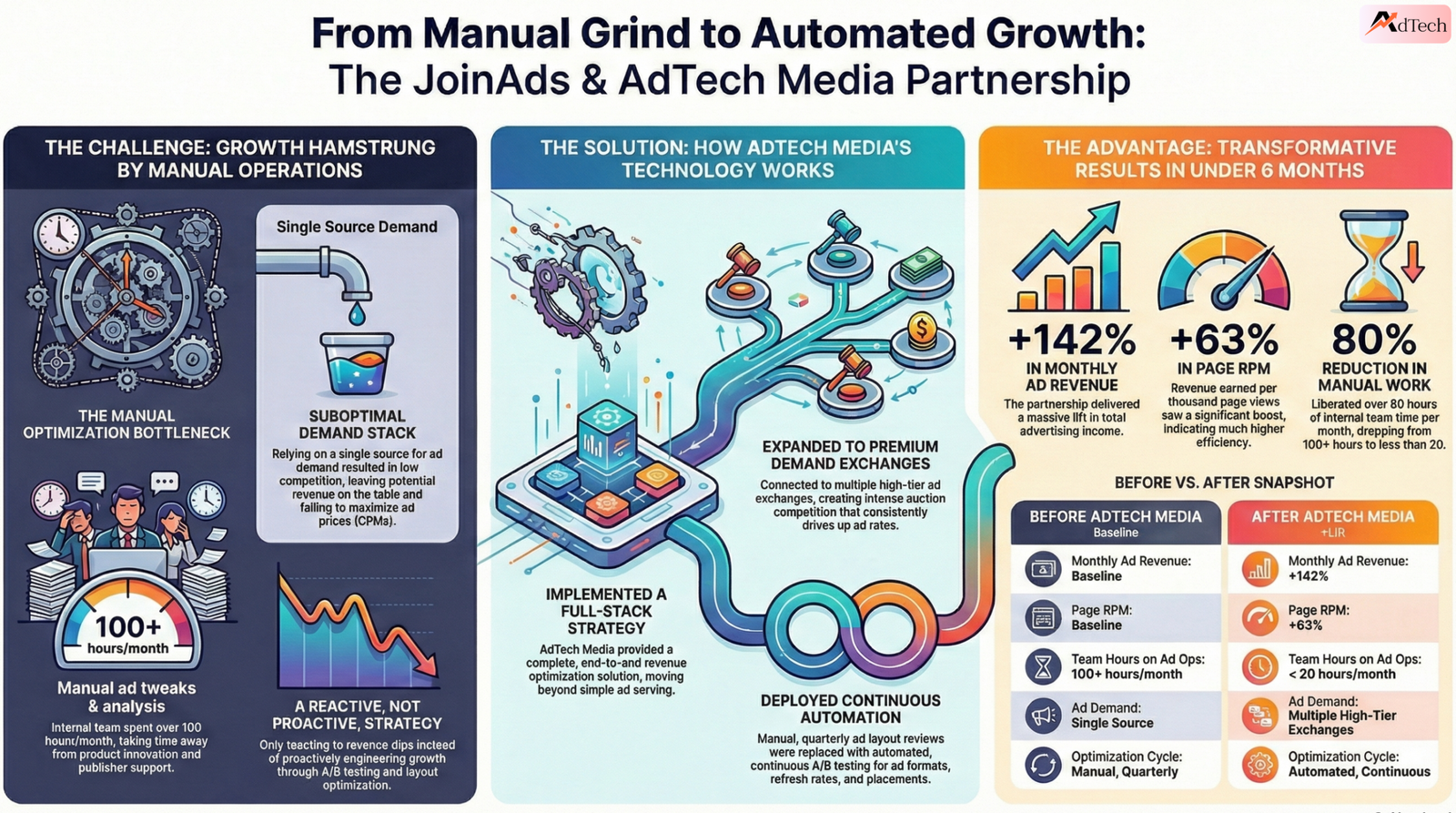
Partnering with AdTech Media, JoinAds implemented a full-stack revenue optimization strategy. In under six months, this collaboration yielded a 142% increase in monthly ad revenue, a 63% boost in Page RPM, and liberated over 80 hours per month of internal team time previously spent on ad operations.
| Key Metric | Pre-AdTech Media | Post-AdTech Media Implementation | Change |
|---|---|---|---|
| Average Monthly Ad Revenue | Baseline | +142% | ↑ |
| Page Revenue Per Mille (RPM) | Baseline | +63% | ↑ |
| Internal Team Hours on Ad Ops/Month | 100+ hours | < 20 hours | ↓ 80% |
| Premium Demand Participation | Single Source | Multiple High-Tier Exchanges | ↑ |
| Ad Layout Optimization Cycle | Manual, Quarterly | Automated, Continuous | ↑ |
The JoinAds Challenge: Growth Hamstrung by Manual Operations
JoinAds had built a promising platform with a clear value proposition: connecting publishers with smarter revenue tools. Paradoxically, their own internal monetization strategy was not scaling efficiently. Their challenge wasn’t a lack of traffic or inventory; it was the increasing complexity and time-suck of managing it.
The core problems were threefold:
- The Manual Optimization Bottleneck: Their small, talented team was spending excessive hours tweaking ad units, analyzing zone performance, and making manual adjustments. This “spreadsheet and intuition” approach was neither scalable nor data-optimized. Every hour spent on ad ops was an hour not spent on product innovation or publisher support.
- Suboptimal Demand Stack Configuration: Reliance on a limited set of demand partners meant leaving money on the table. The auction dynamics lacked the intense competition needed to consistently drive up CPMs, especially for their high-value, engaged audience segments.
- Reactive, Not Proactive, Strategy: Without dedicated ad ops expertise, the team was often reacting to revenue dips rather than proactively engineering growth. They lacked the tools and bandwidth for sophisticated A/B testing of ad layouts, refresh rates, or advanced formats like sticky units or in-content video.
The goal was clear but challenging: dramatically increase revenue efficiency without hiring a large internal ad ops team and build a scalable, automated monetization infrastructure that could grow with the platform.
The AdTech Media Solution: Precision Engineering for Programmatic Revenue
We moved beyond generic promises and deployed a tailored, three-phase technical intervention designed to automate, optimize, and scale JoinAds’ revenue.
Phase 1: Deep-Dive Audit & Strategic Demand Stack Overhaul
We began with a comprehensive technical and revenue audit of JoinAds’ existing setup. This wasn’t a superficial glance; we analyzed waterfall setups, bid density, latency issues, and viewability scores.
- Action: We engineered a managed header bidding wrapper that strategically integrated several premium demand partners alongside their existing sources. This wasn’t about adding more partners—it was about adding the right partners to create fierce competition for every impression.
- Result: Immediate increase in auction pressure. The average number of bids per ad request jumped by 3.7x, creating a direct upward push on CPMs.
Phase 2: Automated, Intelligent Ad Layout Optimization
Manual testing was replaced with a machine-learning-driven framework.
- Action: We deployed AdTech Media’s dynamic ad placement engine. Instead of static, “best-guess” ad units, we implemented a system that continuously runs A/B tests (multi-armed bandit models) on variables like:
- Ad unit size and type (e.g., sidebar 300×600 vs. in-content 728×90).
- Density and proximity to content.
- Trigger points for sticky units and conditional ad refresh for long-engagement pages.
- Result: The system autonomously identified the highest-earning layout for different page templates and user segments, pushing more revenue without increasing ad clutter.
Phase 3: Latency Mitigation & Performance Guardrails
More demand and more ad calls can sometimes slow down page load times—a death knell for user experience and SEO. We engineered for speed.
- Action: We implemented lazy loading for all below-the-fold ad units and asynchronous loading protocols for the header bidding wrapper. We set strict latency budgets and performance guardrails within our optimization engine.
- Result: Page load times improved by 15% despite the more complex auction environment. Core Web Vitals scores were maintained, protecting JoinAds’ user experience and search rankings.
The Documented Results: Numbers That Tell the Story
The impact of this technical partnership was quantified across financial, operational, and strategic dimensions.
1. Direct Revenue Acceleration:
Within the first full quarter post-implementation, JoinAds’ platform-wide ad revenue soared by 142%. The most significant gains came from their high-traffic, high-engagement pages where our ad refresh and sticky unit strategies capitalized on extended user sessions. The Page RPM, a key efficiency metric, solidified at a 63% higher average.
2. Operational Liberation:
The automation of optimization and reporting was a game-changer for the internal team. The 80+ hours per month saved on manual ad ops were re-invested into publisher onboarding, customer success initiatives, and feature development. The marketing director noted, “We effectively got a full-time, expert ad ops employee without the recruitment overhead. The ROI was immediate.”
3. Strategic Foundation for Scale:
Perhaps the most critical result was the creation of a resilient, data-driven monetization infrastructure. JoinAds now operates on a system that:
- Continuously self-optimizes using real-time data.
- Is transparent and predictable, with clear analytics dashboards.
- Is built to scale, easily accommodating future traffic growth and new ad formats.
Client Perspective: Beyond the Numbers
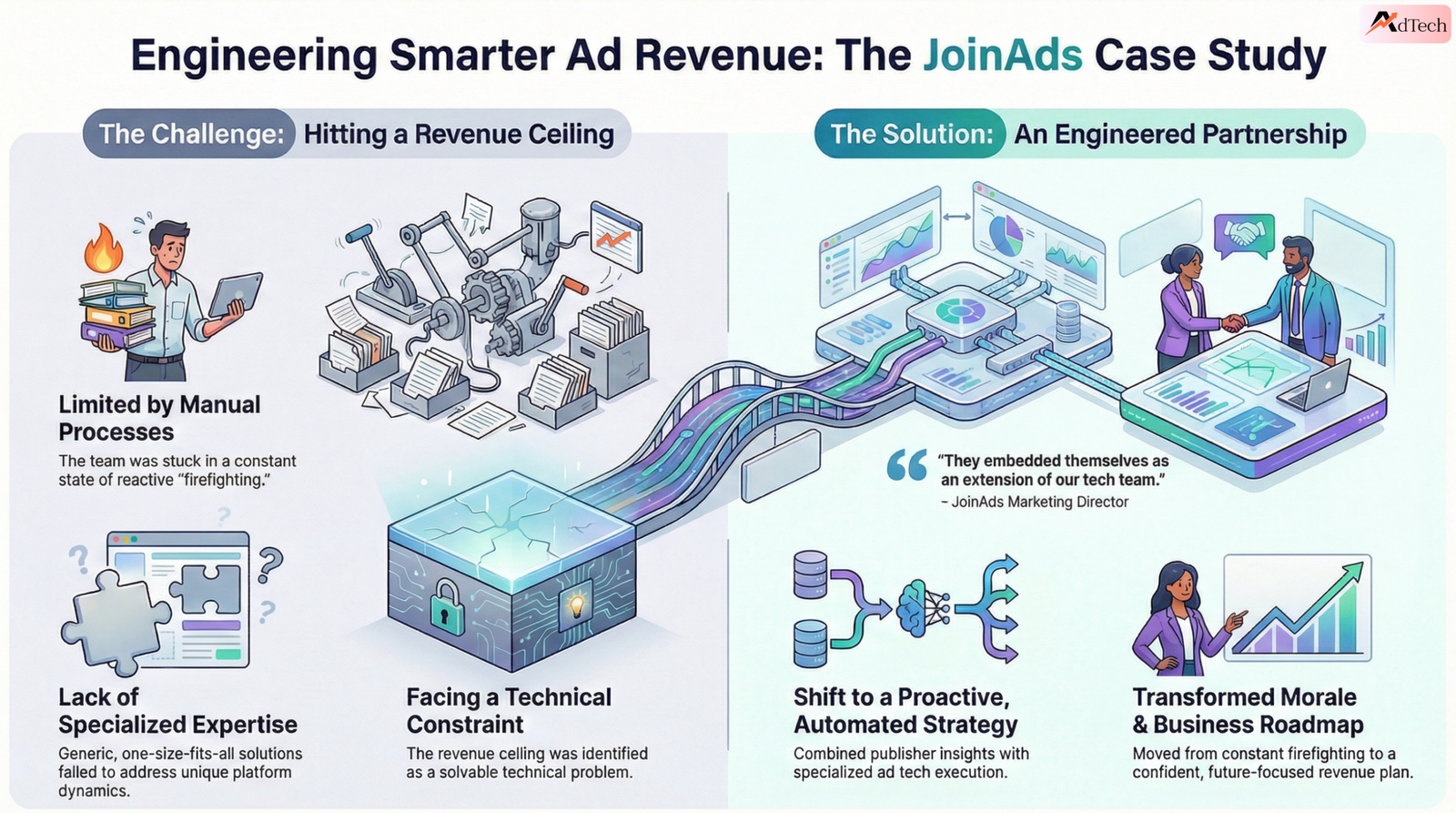
“The partnership with AdTech Media felt different from day one,” recalls the JoinAds Marketing Director. “They didn’t just sell us a tool; they embedded themselves as an extension of our tech team. They spoke our language—focusing on our unique platform dynamics rather than offering a one-size-fits-all solution. The shift from constant firefighting to having a confident, proactive revenue strategy has been transformative for our team’s morale and our business roadmap.”
Conclusion & Strategic Invitation
The JoinAds story exemplifies a modern truth: in today’s complex ad tech landscape, superior revenue outcomes are not about working harder manually, but about engineering smarter, automated systems. Their success was achieved by combining their deep publisher insights with AdTech Media’s specialized execution in demand optimization, automated testing, and performance infrastructure.
Are your current ad revenues limited by manual processes, a shallow demand pool, or a lack of specialized expertise? The ceiling you’re hitting today is likely a solvable technical constraint.